On the Anniversary of the Great Blizzard: March 12-14, 1888
By Amanda M.B. Matava, Digital Archivist
The Great Blizzard of 1888 (sometimes called the “Great White Hurricane”) was one of the deadliest and most unusual snowstorms in American history. It also has the curious distinction of being the first widely photographed natural disaster in the United States. Between March 12 and 14, the storm buried parts of the Northeast under as much as 55 inches of snow, and more than 400 people perished in the frigid temperatures.
Hartford—and Trinity College specifically—were not spared. The city received an estimated 36 inches of snow in an era before salting, sanding, vehicles, and snowblowers.
With the recent February blizzard fresh in mind, I was eager to explore how this historic storm affected Trinity’s campus.
Nothing to Report
On March 17, 1888, the student-run Trinity Tablet reported that “the handsome furniture for the new Jarvis Hall of Science has arrived and is stored in the basement of one of the halls.” The students were excited for the building, which was nearing completion. The College had only occupied its Summit Street campus for ten years. In isolation, nothing of consequence appears to have happened in the days prior.
Yet the archival record tells a different story.
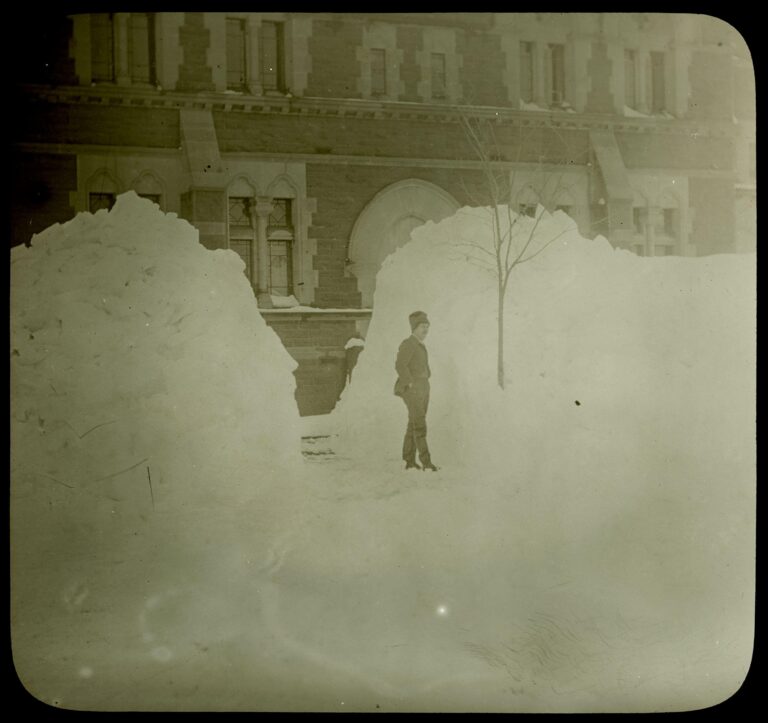
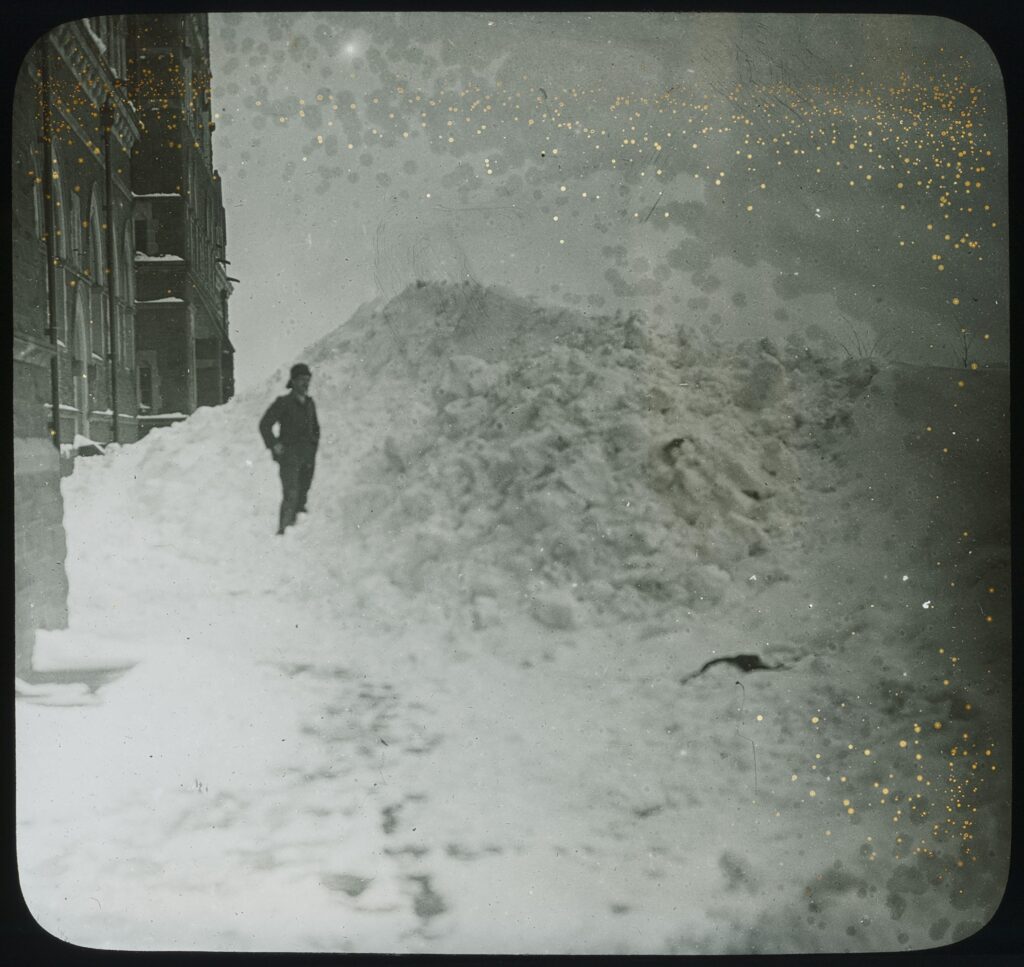
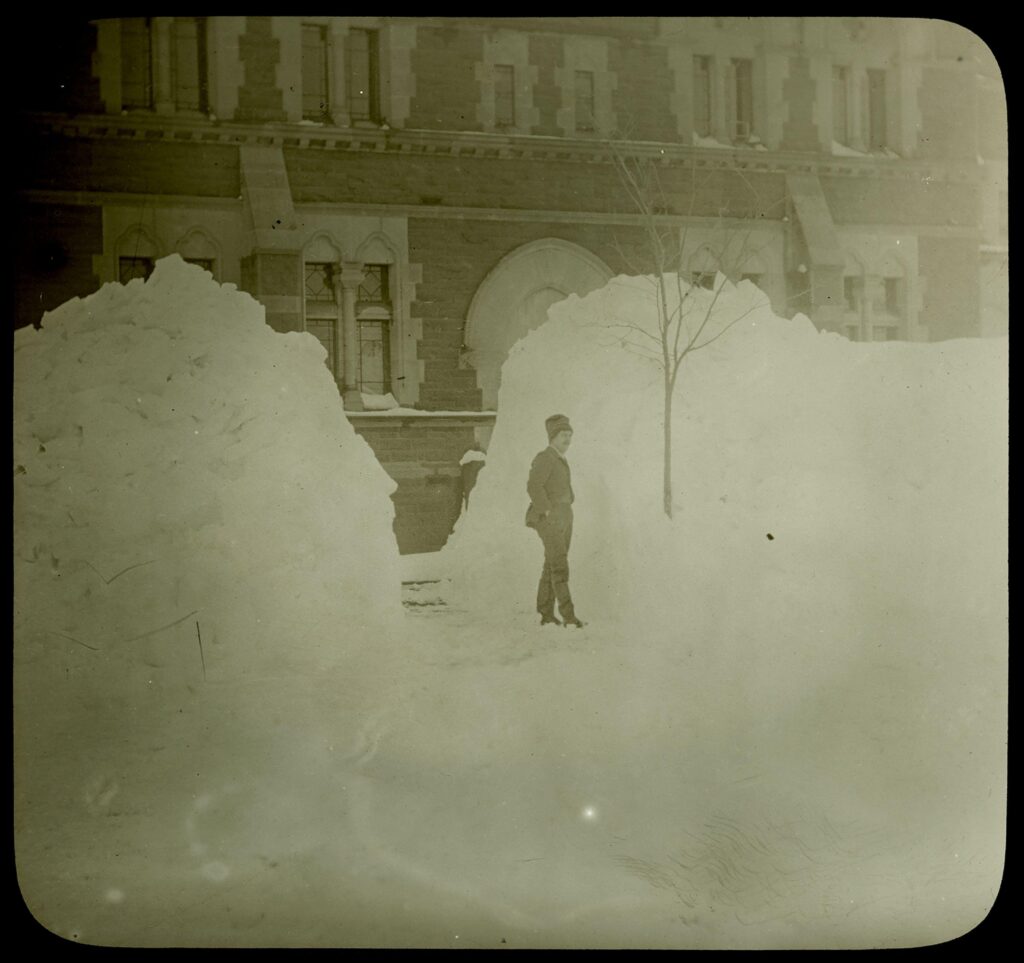
Several prints and glass slides bearing the titles “Blizzard of 1888” have recently been digitized and added to Trinity’s Digital Repository, showing that the blizzard certainly would have impacted College operations and disrupted foot travel in ways not dissimilar to snowstorms today.
The Storm That Paralyzed New England
The blizzard caught New England mostly by surprise. The afternoon of Sunday, March 11 was mild as the rainstorm that was to become the deadliest blizzard in history moved up the coast.
The storm intensified rapidly when it collided with an Arctic air mass. Temperatures dropped from 40° to single-digits overnight, rain turned over to snow, and wind gusts increased to between 40 and 85 miles per hour. The storm stalled over New York City and even looped back on itself without weakening, resulting in extreme snowfall across New England.
“The snow [was] coming in blinding sheets and the wind blowing with blinding fury,” the Hartford Courant reported. “Had the air been still, the snow would have covered the ground to a level of two or three feet, but the wind pulled it in great drifts…many being four to six feet in height.”
Some plowing attempts were made during the storm. They were affixed to the front of horsecars and trains to cut through deep drifts and clear tracks, but “the wind pulled up the drifts across the tracks again as soon as the ploughs had passed.”
Telegraph and telephone lines collapsed, mail and milk deliveries stalled, and trains derailed. By Tuesday, March 13, “the whole country [was] nearly as devoid of means of communication as it was a century ago.”
Many of the fatalities were of people caught in the elements walking home or seeking shelter.
The storm, in short, halted everyday life.
Digging Out
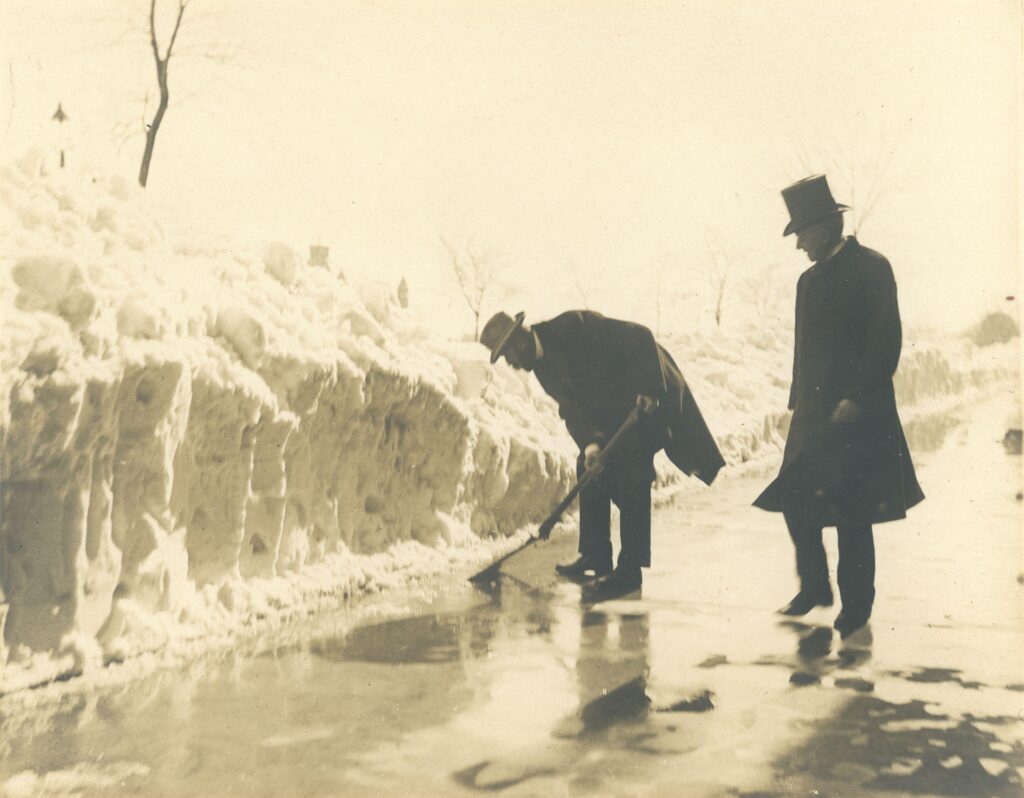
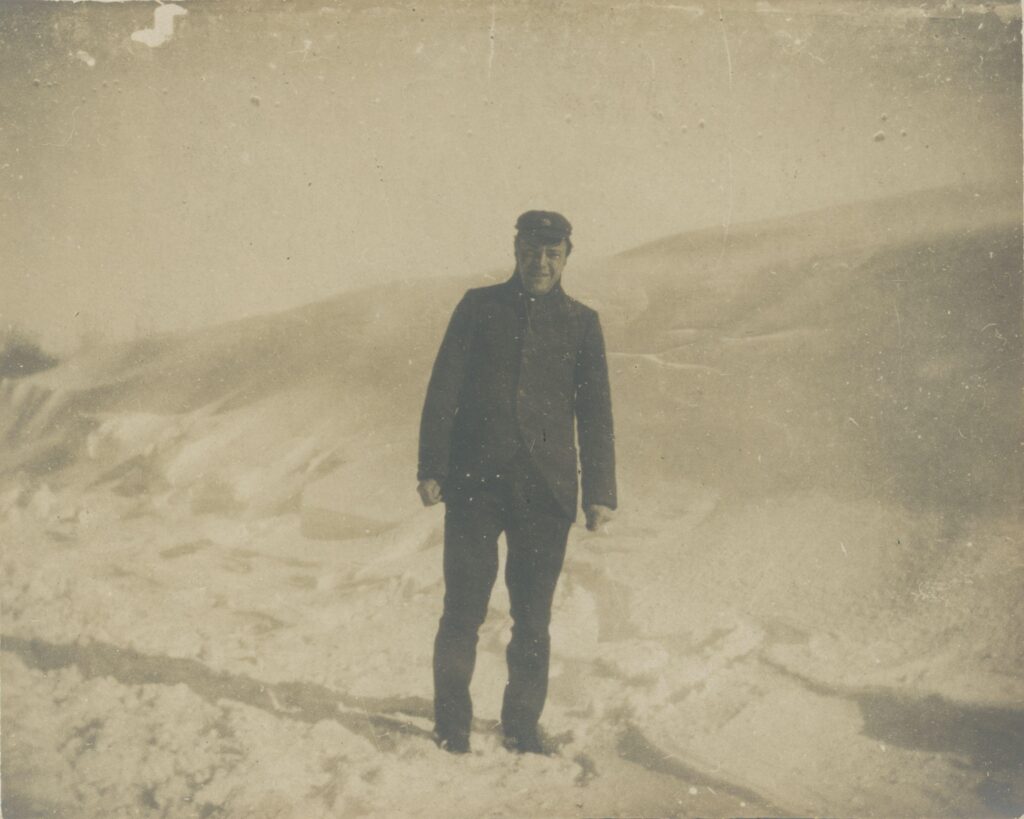
Once the worst had passed, snow removal became top priority. Most snow removal was done by hand. Paid workers and volunteers worked together with shovels, sometimes opting to cut tunnels through towering drifts. When snow had to be moved, it was loaded into horse-drawn carts.
Roads could be cleared through horse-drawn wedge (also called V) or wing plows to deposit snow on the sides of the street. Snow could also be compacted by heavy “snow rollers,” also pulled by horses, and which provided better traction for horse hooves and sleighs. Salting was not practiced, as it was expensive and hard to come by, while sanding was only used for traction on steep hills.
Snow on Trinity’s Hill
Hartford recorded its snowfall totals at Trinity College, but its official measurement—19 inches—was likely far lower than the actual accumulation, which is estimated at 36 inches. Due to Trinity’s elevation, the wind gusts would have blown the snow elsewhere, resulting in lower totals.
By March 16, the “worst was over,” as reported by the Hartford Courant. The state had slowly become operational again.
Life on Campus During the Blizzard
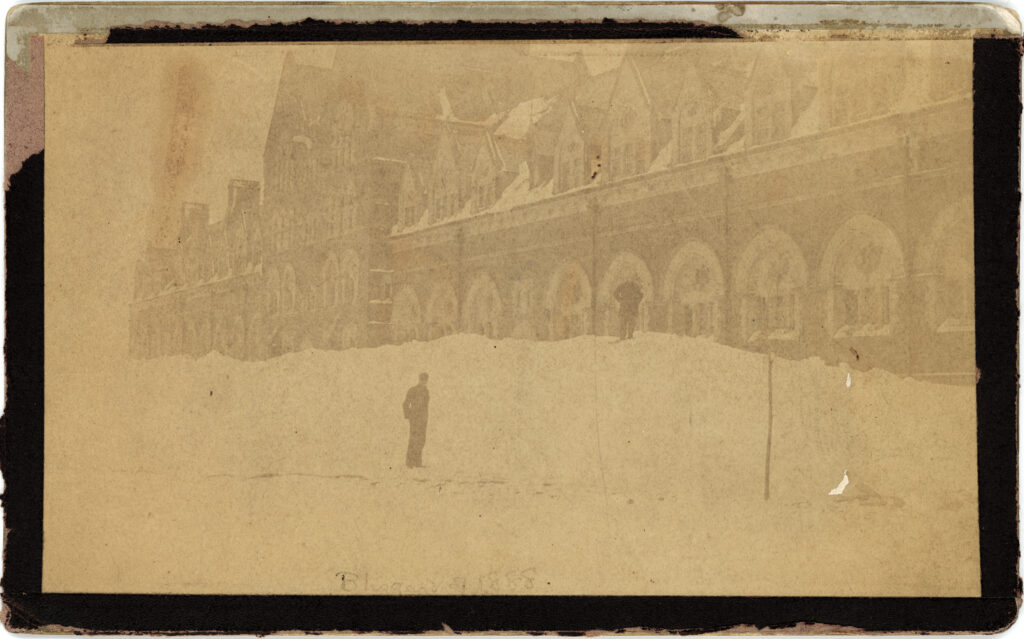
Two students pose at snow mounds by Seabury Hall (the second student is standing on top of the snow). Faded text at the bottom reads “Blizzard of 1888.”
Though no student accounts of the 1888 Blizzard have been discovered, it is not difficult to imagine how the storm might have unfolded on campus. Most Trinity students lived in the Long Walk buildings. As the storm intensified overnight on March 11, many were likely already indoors. Those who were off-campus would have had to remain where they were. The campus would not have electricity until 1893, so students would have used dormitory fireplaces to keep warm and oil or kerosene lamps for light. The telephone service — which was installed in 1880 — would likely not have been functioning.
By morning, the campus would have been buried under deep drifts, with winds still driving snow across the hilltop. Classes may have been temporarily cancelled until paths could be cleared, leaving students effectively snowbound in the dormitories. Once the worst had passed, janitorial and other staff would have begun digging out walkways and clearing the Long Walk.
The photographs preserved in the archives—showing students standing among towering snowbanks—suggest the campus quickly became a place of curiosity and exploration once the storm had subsided.
Later student writings give firsthand accounts that would not be dissimilar to the blizzard’s aftermath. In a 1898 Trinity Tablet column, a student writer self-named “The Stroller” describes “lazily watching the janitors and their assistants shoveling away the accumulated drifts” while strolling down the Long Walk:
“Wherever it was most convenient the snow was carefully shoveled down the gratings before the different sections, to remain there until it melted during the next warm days and ran down into the basements to add its portion to the dampness already accumulated there. It is much easier certainly thus to pack the snow into the open gratings than to carry it across the walk and deposit it on the campus, and perhaps serves the laudable purpose of clearing the walk more expeditiously, which is surely greatly to be desired.”
In an 1882 Tablet, students commend “the prompt way in which the snow has been cleared from the college walks…immediately after a snow-storm,” as “to rush off to recitations and chapel through snow and slush is anything but pleasant” and “to tramp a fourth of a mile to breakfast on a cold morning with the snow two feet deep and not cleared from the sidewalks is more than unpleasant; it is, to use a slang expression, ‘simply beastly.'”
Unrecorded History?
Why didn’t students record their experiences during the Blizzard in the Tablet? It is difficult to say. The Tablet, a monthly periodical, focused primarily on campus events, organizations, and creative works. By the time the March issue appeared, the storm may already have felt like old news—or perhaps it seemed unnecessary to record something everyone had experienced firsthand. Perhaps because nothing disastrous happened, it was treated as just another day.
Whatever the reason, the storm survives in fragments: in newspaper articles, in photographs preserved in the archives, and perhaps in personal diaries now lost to time. Other accounts of snowstorms do exist — piece those fragments together, and a fuller picture of Trinity’s experience during the Great Blizzard begins to emerge.
Images including the ones in this post are freely available for view and download in the College’s Digital Repository, College Archives, Archival Photos and Video Collection.
Sources
Disasters in Connecticut: Blizzard of 1888, Connecticut State Library.
Blizzard of 1888 Photographs, Connecticut State Library
“How Humans Have Handled Snow Through the Ages.” Sarah Pruitt. History.com, Jan 22, 2026.
“The Blizzard of 1888: America’s Greatest Snow Disaster.” Weather Underground, Mar 12, 2020.
“Hey Snow! It’s Not You, It’s Us.” Jason L. Newton. Edge Effects, Oct 12, 2019.
“Blizzard of 1888 Devastates State.” Connecticut History.Org, Mar 14, 2017.
“The Great Blizzard of 1888.” The Hartford Courant, Nov 21, 2001.
“The Stroller.” Trinity Tablet, Feb 19, 1898, p.20.
“TRINITY’S BIG DRIFT: Sixty Tons of Snow in It — Other Weather Notes.” The Hartford Courant, Feb 24, 1893, pg. 10.
“THE WORST OVER: Traffic Beginning Again, Many Railroads now Open, Nearly All Expected to be Clear To-Day, THE BIG STORM SOON TO BE A THING OF THE PAST. Cities and Towns Returning to their Normal Condition.” The Hartford Courant, Mar 16, 1888.
“A GREAT STORM: A Genuine Blizzard MINUS INTENSE COLD The Country Buried in Snow GREAT DRIFTS IN ALL DIRECTIONS General Paralysis of Business.” The Hartford Courant, Mar 13, 1888.
The Trinity Tablet, Feb 18, 1882, p. 1.
Search by Keyword
Search by day
| M | T | W | T | F | S | S |
|---|---|---|---|---|---|---|
| 1 | 2 | 3 | 4 | |||
| 5 | 6 | 7 | 8 | 9 | 10 | 11 |
| 12 | 13 | 14 | 15 | 16 | 17 | 18 |
| 19 | 20 | 21 | 22 | 23 | 24 | 25 |
| 26 | 27 | 28 | 29 | 30 | 31 | |
search by month
Search by Keyword
Search by day
| M | T | W | T | F | S | S |
|---|---|---|---|---|---|---|
| 1 | 2 | 3 | 4 | |||
| 5 | 6 | 7 | 8 | 9 | 10 | 11 |
| 12 | 13 | 14 | 15 | 16 | 17 | 18 |
| 19 | 20 | 21 | 22 | 23 | 24 | 25 |
| 26 | 27 | 28 | 29 | 30 | 31 | |