“For the love of postage – write”: I Found it at the Watkinson!
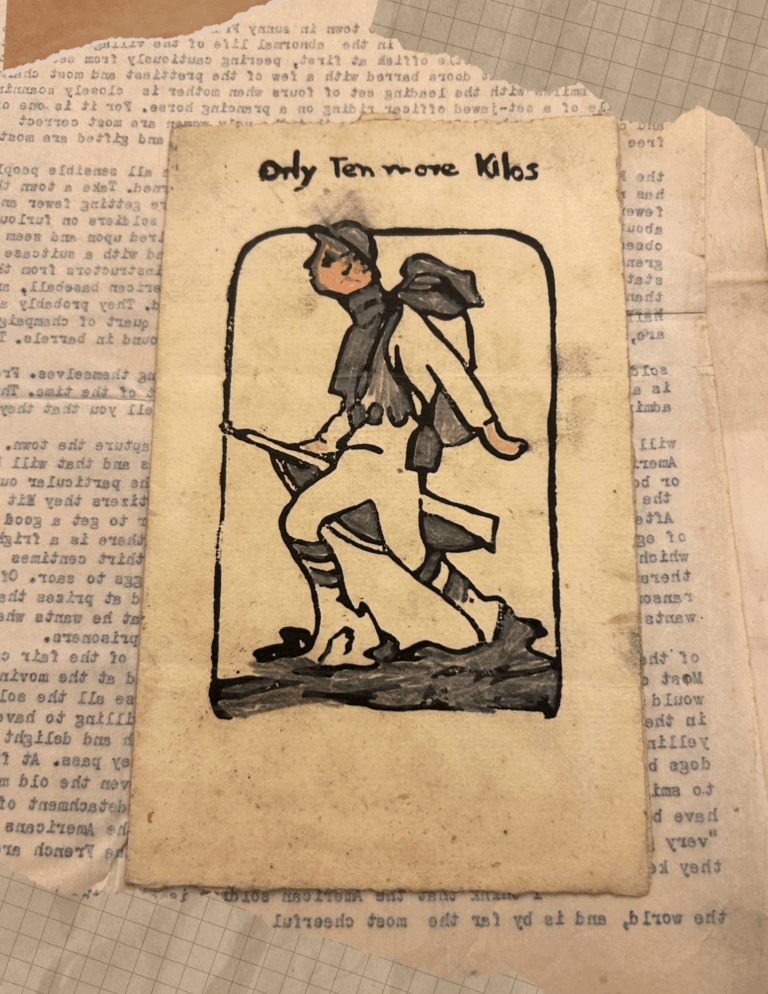
by Emma Markowski ’25, student assistant at the Watkinson Library
The Watkinson recently received a new accession that contained the letters of a young World War I soldier, Edward Bulkeley Van Zile, writing to his family back home in the States. Amongst this soldier’s letters (about 200 in total) were documents pertaining to his father, Edward Sims Van Zile, and his son Neil Fitch Van Zile. However, it was the letters of Edward B. Van Zile that captured my attention the most.
Reading someone’s letters is a peculiar way to get to know them. When they are not addressed to you, it almost feels like eavesdropping on a conversation of which you can hear only one participant, like listening to only one end of a phone call. Letters are special in terms of writing mediums because they are only intended for as few as one person to read; they are private. Yet, here I was, flipping through 200 pages of words intended for a soldier’s parents, witnessing an intimate and casual look into the daily experiences of a World War I veteran.
The letters came to us in six folders and were not organized in chronological order. The first step of processing the collection was to place them in the order in which they had been written, which required my reading of all 200-some letters. Luckily, Van Zile had been incredibly thorough in the dating of his writing, and many of his letters had the full date scrawled upon the top. The letters that had no date required my knowledge of the collection as a whole. When was Van Zile in France? Was he promoted to Corporal in Kansas or Texas? Where had he mentioned the notice board he was writing? In some cases, I could find the exact date, down to the day of the week, of which the letter had been written based on what had been written in dated letters. Other times, it could be only dated to a year or a 4-month span within a specific year. Regardless, the process made me feel as though I knew Van Zile, at least to a certain extent.
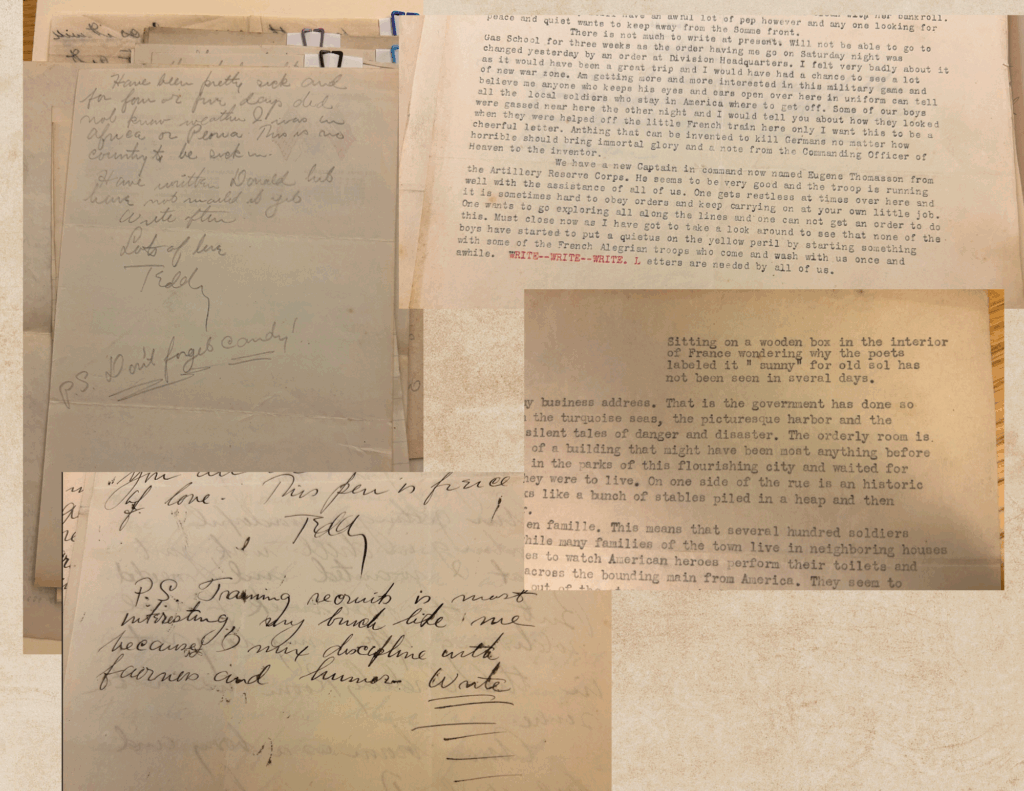
I learned of his love for his sisters and parents, aunts and uncles, his excitement to be an uncle, his wonder, awe, and sometimes disgust over the people he was meeting and the new places he was seeing, his pride of being American, and his fear of being a soldier forever. Though his letters were focused on recounting his day-to-day experiences, a sense of the larger war was still constructed. For example, Van Zile writes back home calmly and without much surprise about the United States’ official entry into the war while he was in Texas. He speaks of crossing the English Channel, of his aviation training (predating the United States’ official air force, Van Zile’s training traced the department’s very beginnings in WWI), and of his experiences in the infamous Meuse-Argonne offensive. He speaks negatively of the Germans, referring to them as “the Boche”1, heinies, and the huns throughout. Though we know these events and opinions to be major moments in both US and world history, Van Zile presents them as the only things he was living through. This helped me to reframe how I thought about these historic moments, and recognize that at one point these were not historic moments, but rather somebody’s present – their sometimes mundane reality.
My favorite letter from the collection builds upon this idea of the quotidian human aspect of war and its soldiers. In August of 1918, while Van Zile was stationed in France, his bunkie had fallen in love, “passionately with the most beautiful little French maiden.” The comical issue in their emerging romance was that she spoke very little English, and the friend spoke no French. The solution was that Van Zile would act as a translator between the two, and for three nights he “acted the role of heart-throb interpreter”. His wing-manning took a toll on him, however, as he writes that he “had lost several pounds under the great mental strain and am going to ask my comrade to lay off the love stuff at least one night a week”. In this same letter, he writes that he and his friend “were invited to come over to the girl’s piazza.” During this visit with the French girl’s family, her mother gave them a careful inspection “and graciously hung their gas masks on a peg in the wall”, just as one would do with their jacket when entering a room. He tells of the kind treatment they received, a taste of domesticity and family missing from a soldier’s life. I find this a particularly moving image. The idea of young men, welcomed around a family table in a foreign country displays genuine human kindness. However, the gas masks loom in the background, just on the other wall. They are symbols of the horrors of war, proof of the inhumane violence that men can inflict upon each other. And here this gruesome symbol was, hanging where one would normally leave their jacket, proving the absurd normalization of the violence which permeated the daily lives of the citizens of warring nations. In these letters back to his mom and dad, Van Zile captures the complex nature of a soldier’s life. It is humanizing to see the flirting, the want of romance, the teasing and wing-manning, and the hospitality, all juxtaposed with the reality of war and deadly mustard gas.
Despite my assertion of the privacy and personal aspects of these letters, it is also clear that Van Zile had some understanding of a larger audience. He frequently asked if his letters were being preserved and saved, telling his parents to collect what he sent them in a wooden box. Van Zile also dabbled in writing beyond letters, creating update notices for military boards, as well as pieces of narrative writing – one-act plays and pages of fiction writing. These literary creations are always centered on soldier life and seem to be drawn from Van Zile’s own wartime experiences. He wrote a lengthy account of his injury on the front lines of Meuse-Argonne, which was published in a newspaper back in the States, reflecting his need, even during his life, for his writing to be read by others. Writing and receiving letters was something incredibly important to Van Zile, and he ended a majority of his letters asking – actually, demanding – his family to write to him frequently. He stated multiple times how dearly he missed them and being home, and emphasized the joy that all soldiers felt upon receiving a letter from home. My favorite of these pleas is pictured below: “For the love of postage – write”.
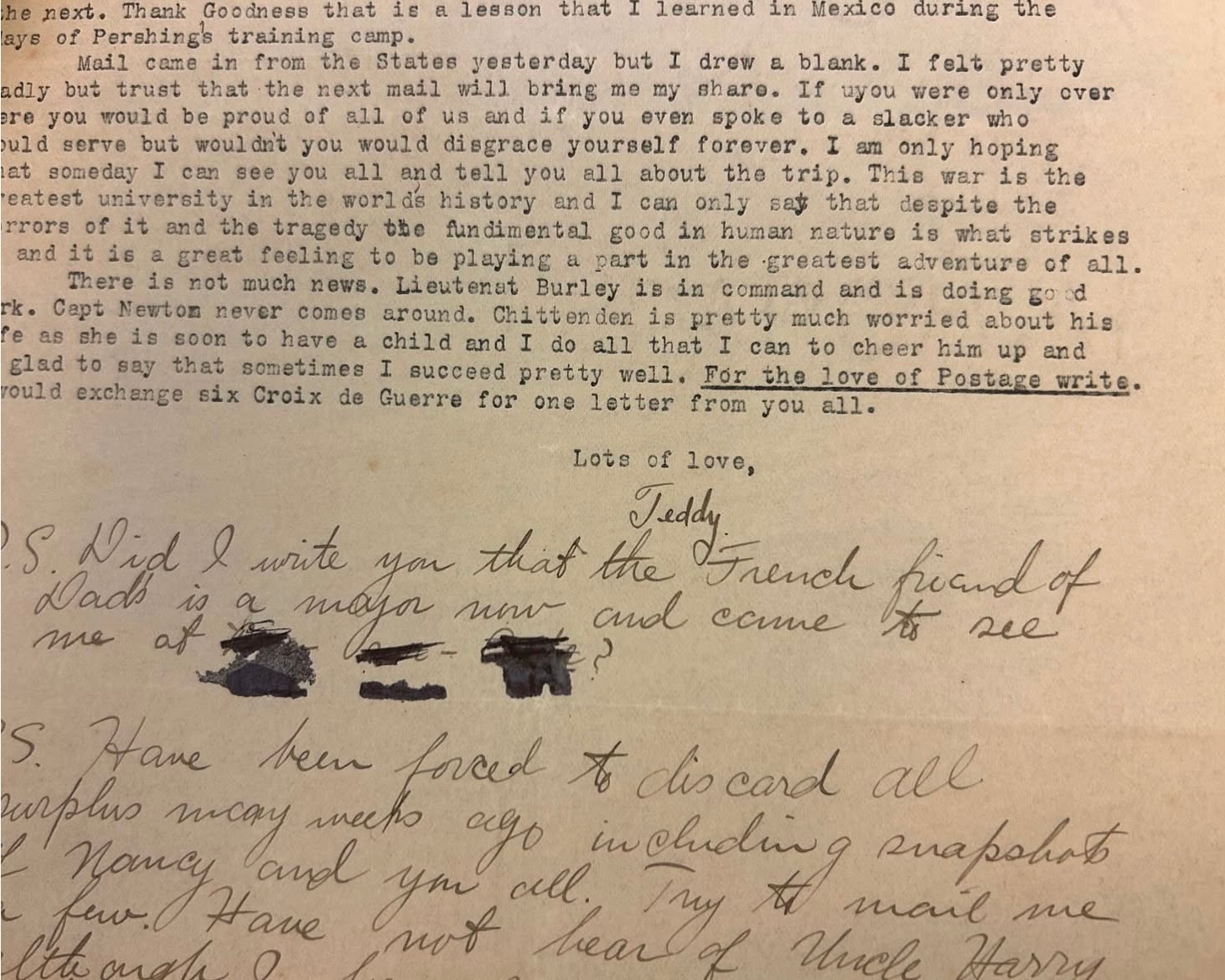
Letters and writing serve as a way to connect people, both within and across generations. They allowed Van Zile to stay connected to his family while fighting overseas, and now allow us to get a rich, if partial, look into his life and the greater state of the world during World War I. With acts of physical writing, especially the practice of letter writing, slowly disappearing in exchange for phone calls, texting, and Google Docs, I find myself echoing Van Zile’s end-of-letter pleas. We don’t know what the future of digital preservation will look like, but there is a long and established practice of preserving physical documents; a letter proves a more tangible and viable family heirloom than a text message. For the love of postage, write!
The Edward B. Van Zile family collection at the Watkinson Library is available for public use, research, and enjoyment during scheduled research appointments between the hours of 9 a.m. – 4 p.m. on Mondays through Fridays. Please contact the Watkinson Library Reading Room (watkinson@trincoll.edu) for more information and to make an appointment to access the manuscript collections of the Watkinson Library and Trinity College Archives.
- French slang. Thought to have derived from a French word meaning rascal or the word “caboche” meaning head (particurally one that is large and thick, a “blockhead”).
↩︎
Search by Keyword
Search by day
| M | T | W | T | F | S | S |
|---|---|---|---|---|---|---|
| 1 | 2 | 3 | 4 | |||
| 5 | 6 | 7 | 8 | 9 | 10 | 11 |
| 12 | 13 | 14 | 15 | 16 | 17 | 18 |
| 19 | 20 | 21 | 22 | 23 | 24 | 25 |
| 26 | 27 | 28 | 29 | 30 | 31 | |
search by month
Search by Keyword
Search by day
| M | T | W | T | F | S | S |
|---|---|---|---|---|---|---|
| 1 | 2 | 3 | 4 | |||
| 5 | 6 | 7 | 8 | 9 | 10 | 11 |
| 12 | 13 | 14 | 15 | 16 | 17 | 18 |
| 19 | 20 | 21 | 22 | 23 | 24 | 25 |
| 26 | 27 | 28 | 29 | 30 | 31 | |